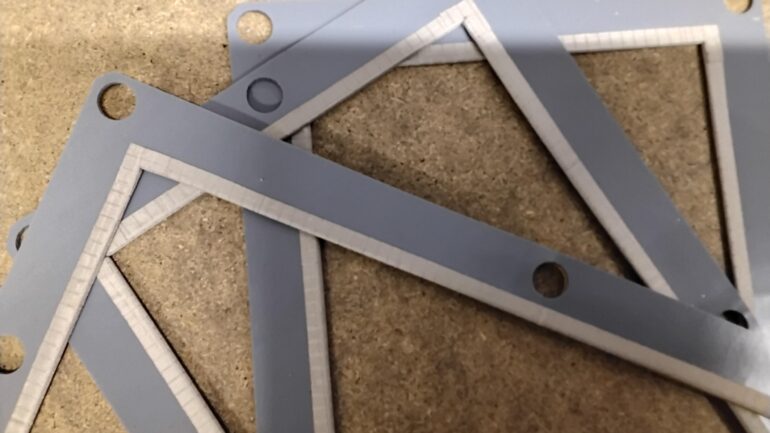
When specifying gaskets for outdoor enclosures, lighting systems, or rail applications, the immediate focus is often on the seal itself: Will it keep water out? While this is the right question to ask, there is a second, more important question that often gets overlooked: How long will it keep water out? Many gasket materials can pass a water ingress test on day one. But after six months of exposure to freezing winter temperatures, baking summer heat, and constant UV radiation, inferior seals begin to fail. This is where Silicone Sponge distinguishes itself from standard commercial rubbers.
The Science of Weathering: Why Gaskets Fail
To understand why silicone lasts longer, we first need to look at why other materials fail.
Organic rubber materials are built on a Carbon-Carbon chemical backbone. Over time, ultraviolet (UV) light from the sun attacks these bonds, causing a process called photo-oxidation.
If you’ve ever seen an old rubber seal that has turned grey, hard, and covered in tiny cracks, you have seen this process in action. Once cracking starts, the gasket loses its compression recovery, contaminants find a way in, and the seal fails.
The Silicone Difference
Silicone is an inorganic polymer based on a Silica (Si-O) backbone. This chemical structure is inherently resistant to UV light and Ozone. It doesn’t just “resist” weathering, it’s practically immune to it. A silicone sponge gasket installed today will look and perform the same way for a number of years.
Key Weather Resistance Properties
1. Extreme temperature flexibility
Most rubbers become brittle in freezing conditions or soft and sticky in extreme heat.
- Standard Rubber: Often becomes brittle at -20°C.
- Silicone Sponge: Remains flexible and active from -60°C up to +230°C.
This makes silicone sponge a great choice for external electronics or HVAC units that must function in sub-zero winters or near heat-generating components (like LED drivers) without hardening.
2. Waterproof closed-cell structure
There is a misconception that “sponge” absorbs water. While this is true for open-cell foams (like the foam used in washing up sponges), silicone sponge features a closed-cell structure.
The nitrogen gas blown into the material during manufacturing creates distinct, non-connecting pockets. This structure allows the gasket to compress and seal against dust and moisture without acting as an absorber for water.
3. Compression set recovery
Compression set is the percentage of the gasket that fails to return to its original height after being compressed.
In outdoor applications, gaskets undergo thermal cycling (expanding in the day when temperatures are higher, contracting at night as temperatures drop). If a gasket has a poor compression set (i.e., it gets flattened and stays flattened), gaps will appear when the enclosure contracts in the cold. Silicone sponge has excellent memory, ensuring it bounces back to maintain positive pressure on the seal, year after year.
When Should You Choose Silicone Sponge?
Silicone sponge is well suited to applications involving:
- LED lighting: Where UV exposure is constant and heat management is critical.
- Rail and transport: Where maintenance intervals are long, and failure is expensive (EN45545-2 compliant grades are available).
- Electrical enclosures: Protecting expensive sensitive PCBs from moisture ingress.
Choosing a cheaper gasket material might save pennies per unit today, but the cost of a failed seal—warranty claims, water-damaged electronics, and on-site maintenance—is far higher.
For outdoor applications where longevity is non-negotiable, Silicone Sponge is the industry standard for a reason.
Need advice on the right density or thickness for your project? Visit cbfrost-rubber.com for more information on general purpose silicone sponge and other high performance materials.