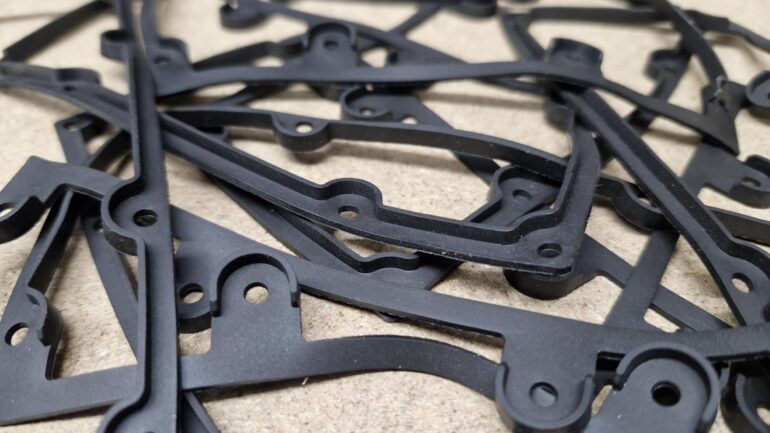
While we may not consistently see the Arctic lows of Scandinavia here, the UK climate is famous for its unpredictability. In some parts of the United Kingdom, a damp, hovering 0°C can plummet to -10°C or -15°C overnight during a sudden “Beast from the East” or a sharp cold snap. For engineers and maintenance managers, this fluctuation of temperature poses a considerable threat: brittle gasket material.
When rubber sealing materials approach their minimum temperature threshold, they don’t just fail instantly; they harden, lose flexibility, and fail to bounce back under compression. A gasket that works perfectly in November might be a rigid, leaking loop of plastic by mid-January.
Are your current gasket materials suitable for withstanding the potential for extreme dips in temperature?
The Comparison: The Silicone Rubber Comfort Zone
Many standard gaskets are specified based on “average” conditions. The problem is that winter throws the averages out of the window.
To understand why Silicone is the superior choice for outdoor or unheated environments, we need to look at the Minimum Operating Temperature of different commonly selected gasket materials; effectively the point where the material is at risk of becoming brittle and failing.
Here is the data based on standard specifications:
- Silicone Rubber (General Purpose)
Minimum operating temperature: -60°C
- MF775 Silicone Rubber
Minimum operating temperature: -55°C
- HT200 Silicone Rubber
Minimum operating temperature: -55°C
- EPDM Rubber
Minimum operating temperature: -30°C
- Neoprene Rubber
Minimum operating temperature: -20°C
- Nitrile Rubber
Minimum operating temperature: -20°C
Why the -5°C to -15°C Range Matters for Gasket Material
Whilst you might look at the minimum operating temperatures for the materials above and think, “If Nitrile and Neoprene work down to -20°C, and the UK rarely drops below -15°C, aren’t they a suitable choice?”
This is a dangerous assumption.
When a material is rated for -20°C, it’s important to remember that is its absolute physical limit. For example, at -15°C, a Neoprene gasket is dangerously close to its failure point. In this “Danger Zone,” the rubber undergoes:
- Increased stiffness: It resists compression, meaning if the joint moves or vibrates, the seal breaks.
- Compression set: It gets squashed and stays squashed, failing to recover its shape.
The Advantage of Choosing Silicone Rubber
Silicone is rated to a minimum temperature of -60°C. When a UK winter hits -10°C, Silicone is operating nearly 50 degrees above its limit. It retains almost all of its flexibility and elasticity, ensuring a tight seal even during the coldest night of the year. While other materials are fighting to stay pliable, Silicone behaves exactly as it does in summer (General Purpose Silicone Rubber is also rated up to +230°C, ensuring it doesn’t degrade in the summer heat or near heat-generating machinery).
In addition to extreme temperature stability, Silicone also has superior UV and Ozone resistance, has strong water repellency characteristics, has excellent compression set resistance, and provides strong electrical insulation.
Don’t Let The Weather Decide Your Uptime
While EPDM is a strong contender for outdoor use due to its weathering properties and ability to withstand temperatures down to a minimum of -30°C, Silicone remains the undisputed king of temperature flexibility. In the unpredictable UK climate, the gap between a -30°C limit and a -60°C limit is the difference between a restless night worrying about leaks and total peace of mind.
Is your facility winter-proof? Check your specifications today. For assistance in gasket material selection, and for high-performance gasket manufacturing services, you can visit cbfrost-rubber.com.